



When Pat Wotton arrived at her winter home in Florida this year, she wasn’t feeling the usual lift that comes with sunshine and sea air. Instead, she carried what she describes as a “heavy heart”—weighed down by personal challenges, a sense of cultural unease and a news cycle she found difficult to process. Scrolling through the events calendar at Marie Selby Botanical Gardens, she paused over something called a “Forest Therapy Walk” at the Historic Spanish Point campus. She hesitated before signing up. “I wasn’t sure what to expect,” she says, “but I figured, how would things ever change if I didn’t try to change them?”
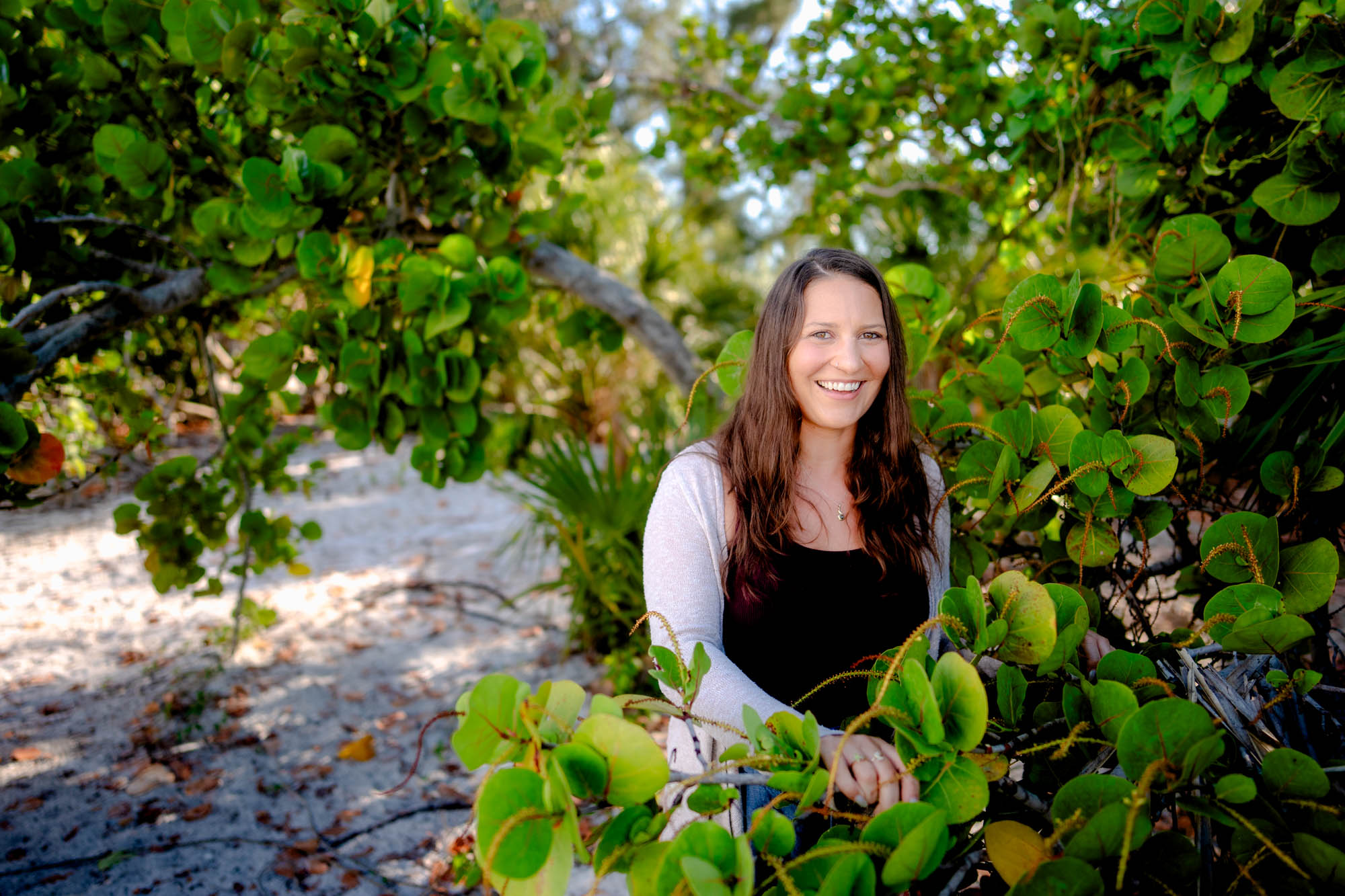
What Wotton found wasn’t therapy in the traditional sense, but a guided experience that slowed her mind and shifted her attention. “Through getting reintroduced to my senses,” she says, “I was able to lift the cloud over my head.” Wotton’s experience is part of a growing movement known as nature therapy, an umbrella term that includes forest therapy and ecotherapy. Rooted in ancient and Indigenous traditions and increasingly supported by modern research, nature therapy is gaining momentum as more people seek alternatives—or complements—to conventional mental and physical healthcare. In our area, local practitioners are helping people reconnect with themselves through intentional engagement with the natural world, using approaches that range from guided group walks to one-on-one therapeutic sessions outdoors.
The forest therapy walk that Wotton attended at Spanish Point was led by Deborah Skorupski, a certified nature and forest therapy guide who offers them regularly from October to April. “A lot of people don’t understand that there’s a difference between someone just taking you for a walk in the woods and a professionally guided forest therapy walk,” Skorupski says.
Skorupski became certified in 2021 through the Association of Nature and Forest Therapy after discovering the practice during the Covid-19 pandemic. As a litigation attorney, she’d spent 25 years in high-stress environments and saw firsthand how disconnected people had become—from their bodies, from nature and from any sense of calm. “When the pandemic hit, the one place we could be was outside,” she says. “As I started learning more about the therapeutic benefits of forest therapy, I knew this was something I wanted to share with people.”
Forest therapy—sometimes referred to as “forest bathing”—has its modern origins in Japan, where the term shinrin-yoku was coined in the 1980s after researchers noticed a rise in stress-related illnesses alongside increased technology use. Studies found that time in forests lowered blood pressure, improved sleep and reduced anxiety and depression—results compelling enough that Japan established designated forest therapy trails within its national parks and forests.
As a certified guide, Skorupski leads participants through an intentional sequence of simple “invitations” designed to slow neurological activity and heighten sensory awareness. Participants wander for a few minutes on their own, perhaps tuning in to certain colors or patterns, with no right or wrong way to engage. “If you get distracted by something unexpected,” she says, “then that’s exactly what your body needs in that moment.”
Central to the practice are two symbolic thresholds. “The first is connection,” Skorupski says. “You’re stepping out of the human world and into the natural world.” Some participants mark this moment by stepping over a stick placed on the ground. At the end of the walk, a tea ceremony signals the second threshold: incorporation. “It’s about setting the intention to bring what you experienced back into your daily life,” she says.
Research shows that time in nature can reduce cortisol levels and inflammation in the body while also boosting immune function and white blood cell production. Skorupski explains that trees and plants release compounds called phytoncides into the air and soil to strengthen nearby trees under stress, and these compounds can also be absorbed by the human body. “When you spend time outside,” she says, “you’re actually helping your body create the exact cells it needs to heal.”
While often experienced in groups, nature therapy is also becoming an integral part of one-on-one mental healthcare. “We call nature the co-therapist,” says Lauren Radakovich, a licensed mental health counselor and certified ecotherapist at Harmony Harbor Counseling and Wellness in Sarasota. “She’s always present in the background of the work we’re doing.” Radakovich’s path to ecotherapy began with an interest in biophilia—the idea that humans are biologically wired in our DNA to connect with nature. Her research came to life while working at a therapeutic school for at-risk girls in central Florida. “We basically lived in the woods with them for two years,” she says, “and the changes we saw from spending time in nature were incredible. The girls gained so much confidence.” After completing specialized training in ecopsychology in Portland, Oregon and working on a therapy farm there, she moved to Sarasota, where she noticed a gap in local offerings. “Florida is a great place for this,” she says. “We have the weather, the biodiversity and so many accessible natural spaces.”
Radakovich meets clients in parks and green spaces for walk-and-talk sessions or simply sits with them outdoors. “Some people find that more approachable than sitting in an office and making eye contact,” she says. “We can walk in silence if needed. Whatever shows up in nature—a bird, the wind—can become part of the session.” Though the setting may appear idyllic, Radakovich emphasizes that ecotherapy is especially effective for deeper psychological work. “Finding a sense of safety in the body is what trauma work really entails,” she says. “We don’t always need to tell our stories to heal. Sometimes we need to learn how to stay present in the now without the past overriding it.” One of the first shifts Radakovich notices in her ecotherapy clients is a change in thought patterns. “Our brains tend to ruminate on negative thinking,” she says. “Nature helps people pause, take a beat and change the channel more quickly.”
By the end of her forest therapy walk at Spanish Point, Pat Wotton found herself moving differently—not just more slowly, but more attentively. One of the tools she took with her was simple: slowing her pace enough to truly notice what's around her. It's something she now carries into her daily life. SRQ Lauren Radakovich, harmony-harbor.com/lauren-radakovich/ Deborah Skorupski, deborah@fnft.earth